
Record-High Safe2Tell Reports Point to Increased Youth Mental Health Concerns
Leer en español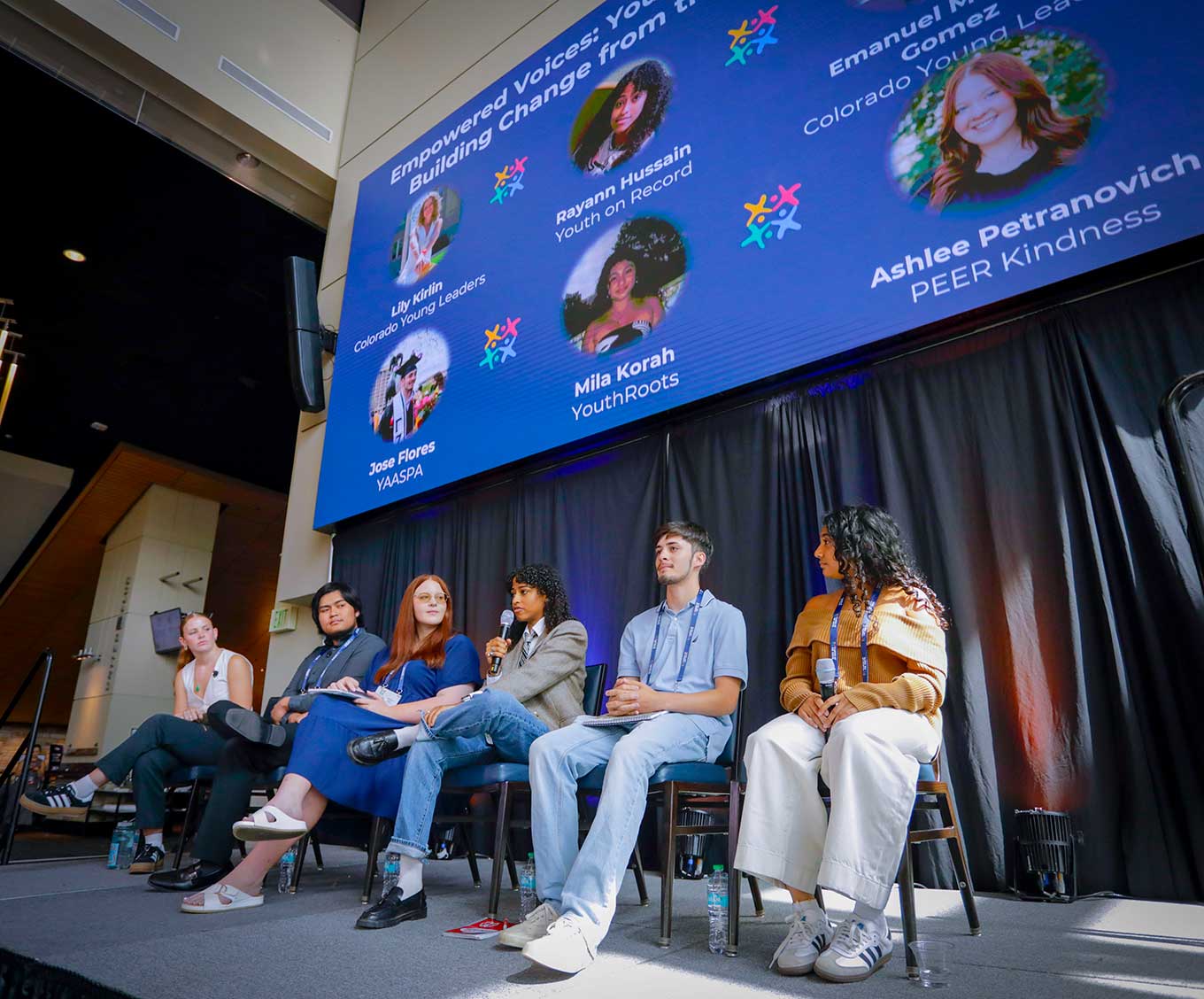
Youth mental health advocates, including former Safe2Tell ambassador Ashlee Petranovich (third from the left), speak on Thursday, July 17, 2025, during a panel discussion called “Empowered Voices: Youth at the Root of Change” at the Teaming Up for Youth: A Mental Health and Wellbeing Huddle event at Empower Field at Mile High in Denver, Colo. The daylong conference was hosted by the Colorado Attorney General’s Office and the Denver Broncos Foundation. Photo by Joe Mahoney/Special to The Colorado Trust
By Saja Hindi
A school psychologist making inappropriate comments and sexually assaulting a student. A student discussing using drugs to sexually manipulate others. Another student driving with alcohol in a car. A young person using social media to harass and bully others. A student reporting being abused at home and feeling suicidal.
These are among the 31,177 reports submitted during the 2024-25 school year—a 10.5% increase over the prior school year and the highest on record—to Safe2Tell, a statewide program that allows parents, students and community members to make reports anonymously (in English and in Spanish) by phone, text or online about threats to their own safety or that of another person.
The Safe2Tell program was created after the 2001 Columbine Review Commission issued a report about improving school safety and emergency responses. The recommendations followed the 1999 Columbine High School shooting. The Colorado Trust funded the development of Safe2Tell’s nonprofit entity in 2003, and the foundation provided additional grant dollars in 2006. The Colorado Trust also gave its first John R. Moran, Jr. Grantee Leadership Award to the Safe2Tell program in 2007. The Colorado Attorney General’s Office has managed Safe2Tell since 2014.
In September of 2025, Safe2Tell saw a surge in reports after the Evergreen High School shooting, receiving 3,846, the second-highest monthly total. (The highest was in September 2024 at 4,729 reports, fueled by viral social media misinformation.)
But it’s not just reports about violence from others that get submitted. Suicide threats were the most reported concern in the 2024-25 school year. The program received 2,603 reports in March 2026 (the latest data available). The top concern that month was school safety, with 487 reports, followed closely by bullying (436) and mental health (435).
The data reflect a growing youth mental health crisis, which Colorado Attorney General Phil Weiser called “both urgent and deeply complex” in a speech at a one-day youth mental health conference in July 2025. (The Colorado Trust was one of the Teaming Up for Youth: A Mental Health and Wellbeing Huddle event sponsors, which the attorney general’s office and the Denver Broncos Foundation hosted.)
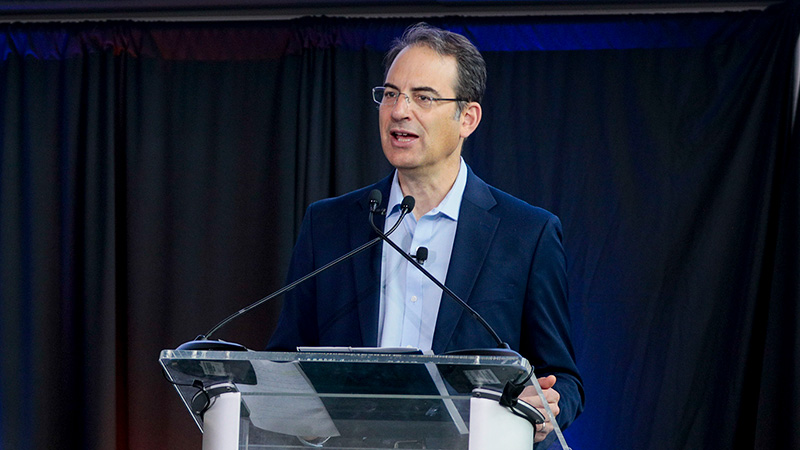
Colorado Attorney General Phil Weiser welcomes attendees and speaks about the growing mental health crisis for youth at the Teaming Up for Youth event on Thursday, July 17, 2025, at Empower Field at Mile High in Denver, Colo. Photo by Joe Mahoney/Special to The Colorado Trust
In January, one report to Safe2Tell stood out: A student posted inappropriate artificial intelligence-generated images about other students online, highlighting the growing connection between emerging technologies and youth mental health issues. In response, the school instructed the poster to remove the images, notified parents and took disciplinary action, according to the monthly report summary.
“The arc of Safe2Tell is a fascinating story because the initial motivation was school safety and school shootings,” Weiser said in an interview. “And during the entire time that I’ve been attorney general, the issues around mental health and emotional well-being, whether it’s suicide, self-harm, bullying or general welfare, those predominate by a pretty clear number over the type of threats that Safe2Tell was originally founded on.”
Weiser noted a rise in rates of anxiety, depression and suicide in young people, as evidenced by Safe2Tell reports and public health survey data, as well as young people’s struggles with well-being and inequities that contribute to poor mental health and access to care.
“We hear a lot about school shootings, which are a terrible and unfortunately recurring reality,” Weiser said. “We don’t hear as much about those who die by suicide, and more young people die by suicide than in a school shooting or a homicide.”
The Centers for Disease Control and Prevention’s 2023 Youth Risk Behavior Survey indicated that 4 in 10 high school students reported feeling persistently sad or hopeless, Weiser noted at the youth event.
Ashlee Petranovich, a former Safe2Tell student ambassador at her Montrose high school in 2021-24, spoke at the Teaming Up for Youth conference about her involvement with PEER Kindness (an anti-bullying nonprofit) and the importance of rallying together to create spaces where people feel safe, supported and heard.
“I truly do believe that no one on this earth should feel as though they are alone,” Petranovich said during a panel discussion. “So, I knew that if I would be able to take a proactive approach to mental health instead of a reactive one, I would be able to create change in my community.”

Community leaders, youth advocates, school representatives and mental health professionals gathered on Thursday, July 17, 2025, at the Teaming Up for Youth: A Mental Health and Wellbeing Huddle to discuss youth mental well-being at Empower Field at Mile High in Denver, Colo. Photo by Joe Mahoney/Special to The Colorado Trust
The same drive to ensure her community is safe prompted Petranovich, now a Colorado Mesa University student, to become a Safe2Tell ambassador at her high school.
Students, parents and community members can report concerns or threats to safety by calling Safe2Tell at 1-877-542-SAFE (7233), filling out a form on the website, using the mobile app or texting S2TCO to 738477. The person taking the report may ask follow-up questions and confirm receipt. An analyst then sends the information to local partners, including schools, law enforcement and mental health professionals. Reports can be made at any time of the day or night.
A 2007 Colorado law established procedures to guarantee callers’ anonymity. In addition to taking reports and forwarding tips to the appropriate parties, the program provides training and resources, including an annual mandatory training for school resource officers.
Susan Payne, founder and former executive director of Safe2Tell, noted that shootings like Columbine High School’s highlighted the problem that information wasn’t being shared between schools and law enforcement, and that not everyone knew what signs to look out for to prevent violence, or they were afraid to report it.
That’s where Safe2Tell comes in. It not only allows young people to anonymously report concerns about violence but also about their peers’ mental health (though it’s also open to reporting by adults). And it goes beyond reporting, involving a multidisciplinary team that determines the steps to take based on the information provided, whether it’s a school taking disciplinary action, police getting involved, parents getting notified, or mental health professionals connecting with someone who needs help.
Payne, who has 28 years of experience in law enforcement, has advised the federal government on school safety and violence prevention and now works as a senior vice president of crisis response and active assailant risk for a private firm. She also continues to train and assist other states on violence prevention and early intervention.
“It took many years, especially the early years, of breaking down the barriers, the silos. … It wasn’t just responding to a 9-1-1 level emergency,” Payne said of Safe2Tell. “It was a much lower threshold of a concern of safety that required an intervention.”
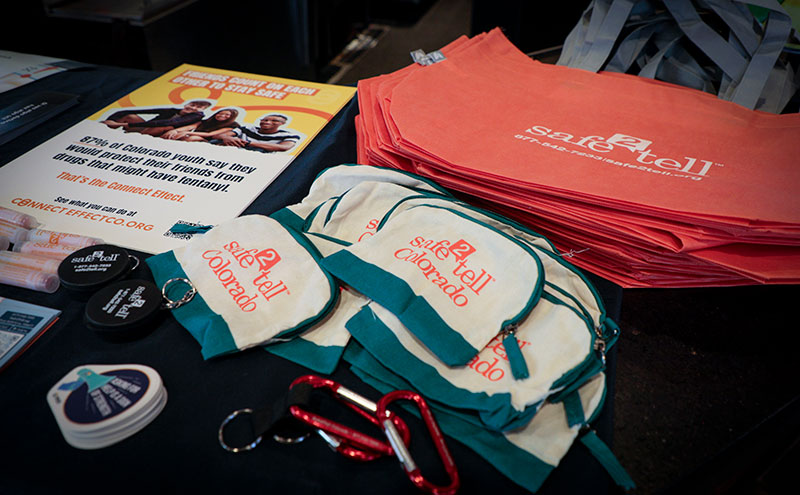
Information and Safe2Tell-branded materials were displayed on a table at the Teaming Up for Youth event on Thursday, July 17, 2025, at Empower Field at Mile High in Denver, Colo. Photo by Joe Mahoney/Special to The Colorado Trust.
But now the program is nationally recognized, and several states have modeled their own programs after Colorado’s, though the Safe2Tell moniker is trademarked for Colorado.
A lot of work has been done to “break the code of silence,” as Payne and others refer to it—“when we’re educating and making people aware, we’re showing them how their voice matters, and there’s a protected way to use their voice to help others, to recognize, ‘hey, that’s concerning,’” she said.
Still, some students worry about “snitching.” That was Petranovich’s experience, so, as the sole Safe2Tell student ambassador at her school and the only one on the Western Slope at the time, she worked to educate her peers about the program and “breaking the code of silence.”
“It’s hard to advocate for safety when there are a lot of barriers around from your peers about, like, ‘hey, if you use that, you’re using it to harm us. You’re using it to humiliate us,’ and things like that,” she said.
Information about Safe2Tell was plastered on posters hanging on the school walls and even on the back of student IDs, but unless students had used it, Petranovich felt like they didn’t really know what it was, and conversations about it were stigmatized. So, she worked with other ambassadors in the state and later with other student leaders at her school to get the word out about how Safe2Tell is actually a benefit to students.
Petranovich recalls two reports she had to make about students at her school: one based on an Instagram post of someone writing about wanting to die by suicide, and another from an Instagram post where a person was actively bullying another. In both cases, she didn’t feel she could have a conversation with either student or change anything. But she felt like she could use Safe2Tell to get them the help they needed.
Even though she made the suicidal ideation report during her senior year and in her third year as a Safe2Tell ambassador, it was still nerve-wracking and a fight against the almost ingrained notion of not “snitching” on her peers.
But deep down, she said, she knew it was the right thing to do.
“It’s that internal [voice] in you that’s just like, ‘we need to go get help for this person,’ and so I had to really tune into how it felt rewarding that I could help someone, and even though, in that moment, maybe they couldn’t see it, maybe they couldn’t recognize that as help, I was able to make sure that they were safe,” she said.

Ashlee Petranovich (left), former Safe2Tell school ambassador, smiles as fellow panelist Rayann Hussain from Youth on Record, a Denver-based nonprofit that works to empower young creatives through mentorship, speaks at the Teaming Up for Youth event on Thursday, July 17, 2025, at Empower Field at Mile High in Denver, Colo. Petranovich was speaking as part of PEER Kindness, a Montrose-based nonprofit focused on reducing bullying, during a youth mental health panel discussion. Photo by Joe Mahoney/Special to The Colorado Trust
That’s the kind of cultural shift Petranovich also began to see among her peers. She remembers one day at school when someone had threatened to bring a weapon, and someone else reported it to Safe2Tell. The school went on lockdown for several hours, even though ultimately, the person who made the threat didn’t follow through.
“It just stuck with me, because it was like, I feel like actual change was happening in the culture,” she said. “For me, it’s like, finally, people are catching on that safety is not just about me, it’s about everyone around me. And so, I love that shift.”
In the 2019-20 school year, Weiser’s first as attorney general, Safe2Tell received 20,822 reports. That number surpassed 31,000 in the last school year. (Officials say more than 97% of reports are valid, and penalties for false reporting have increased.) Weiser said that’s indicative of the program’s success, with more people knowing about it and reporting concerns, but it also highlights the increased challenges youth face every day.
The nature of schools, however, means that education and outreach efforts have to continue year after year as new students enroll and the older ones leave, particularly amid a worsening youth mental health crisis, Weiser noted.
Safe2Tell is working in conjunction with other efforts under the attorney general’s office and in partnership with community members and organizations to address youth mental health and well-being—an issue Weiser said he didn’t realize would become quite so prominent for his office when he was first elected in 2018.
“The thing about Safe2Tell—and it’s similar to this [Teaming Up for Youth] conference—we’re building a community response,” he said in an interview. “And Safe2Tell has worked hard to build a community. It includes school Safe2Tell ambassadors who are kids. It includes school resource officers. It includes mental health professionals at schools. It includes partners in the community.
“That shared effort, that team effort, is going to be crucial for everybody to make progress.”
