
Sight-impaired Senior Keeps Her Independence
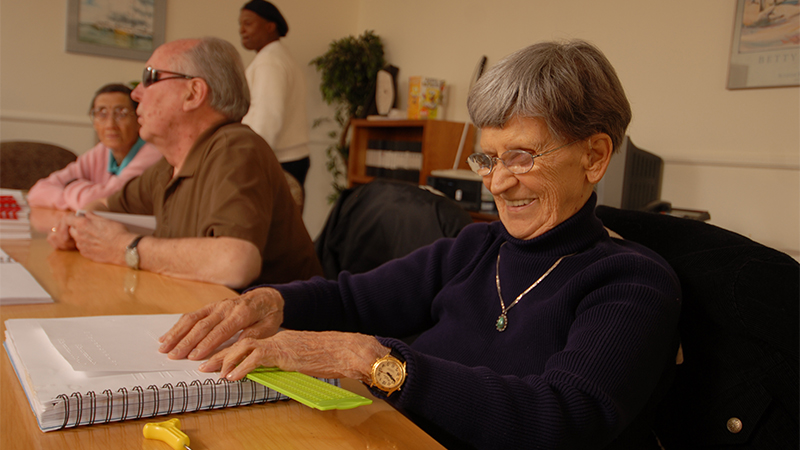
With in-home training, and weekly support groups and classes, Marie Dambrosky and other sight-impaired seniors are gaining the necessary skills and confidence to lead independent lives.
At 88, Marie Dambrosky had no time to waste when the vision in her good eye began to disappear.
She had struggled with glaucoma and cataracts for years. A failed surgery in her 40s left her blind in one eye, but she managed fine with vision in the other and worked for years at Arapahoe Community College. Late in life, however, macular degeneration was creating dark blotches in the center of her focus. Print from magazines used to spring off pages for her. Now, only the shadowy rim of images remained.
Dambrosky refused to give up her independence. So, she got busy trying to find help and connected with the Colorado Center for the Blind (CCB), a grantee of The Colorado Trust’s Healthy Aging initiative.
“It’s a Godsend,” Dambrosky said of the Center. “It’s a morale-builder. It’s a skill builder. Without them, my life would be very empty.”
The CCB is helping hundreds of seniors to remain independent and live richer lives. Nearly all of the seniors who seek help there have recently lost all or part of their vision. Macular degeneration is now the leading cause of blindness. Many seniors come to the center depressed and fearing isolation. With individual in-home training, weekly support groups and classes from Braille to computer skills, and cane travel to cooking, many seniors make peace with their vision loss.
“It’s critical for seniors to be in their home environment,” said Julie Deden, the CCB’s executive director. “Keeping seniors in their homes prevents depression and keeps people integrated in all of the things they have been doing.”
Dambrosky has lived in her Denver home since 1946. Every creak in the floorboards reminds her of treasured times with her husband and three children. For more than 60 years, she has cooked in her kitchen, worked the dirt in her garden and greeted the birds outside.
Specialists have customized Dambrosky’s appliances by placing tactile markings so she can find her way without sight. When she wants to make her morning tea, she simply touches her microwave to find the right buttons. With such new adaptations, she is living much as she always has—she still joins fellow women ham radio operators for weekly chats, uses her computer for e-mail, has forms that help her write her own checks and attends church regularly.
Tuesday mornings at CCB are the highlight of every week. For everyone there, Dambrosky is a beacon of hope. At the CCB’s annual Possibilities Fair, Dambrosky even conducted her own cooking seminar, showing fellow seniors how they could keep chopping vegetables and measuring ingredients.
“She’s a real source of encouragement. She’s learning Braille. She’s living independently. It helps others think, ‘Maybe I can do that too,'” said Duncan Larsen, the CCB’s senior services coordinator.
“If you’re 65, you can’t look at Marie and say, ‘I’m too old to learn Braille.”
Dambrosky knows it will take her about two years to master Braille. So, she practices at home. “I love learning new things,” Dambrosky said. “The Braille is a challenge to me. I cannot guarantee how adept I’ll be, but I’m working on it.”
