Care Coordination and the Health Care Workforce
By Laurel Petralia, The Colorado Trust
Myriad health care improvement opportunities are available as implementation of the Affordable Care Act ramps up. Still, questions remain as to whether Colorado has a sufficient health care workforce to meet the increased demand for health care services. According to the Colorado Health Institute, over 500,000 Coloradans will gain access to health insurance between 2014 and 2016, which in turn will require an additional 83 to 141 primary care providers.
In addition to the need for additional clinicians, there also are workforce issues related to the distribution of health care workers and shortages in fields such as behavioral and oral health, particularly in rural communities. To address such workforce issues, The Colorado Trust continues to convene the Health Care Workforce Collaborative comprised of 127 thought leaders representing policy, government agencies, health care providers, educational institutions, economic development and workforce planning. Established in 2008 through a three-year, Trust-funded workforce investment grant strategy, the Workforce Collaborative was created to better understand the complex nature of health workforce policy and to develop and support effective changes. The Collaborative reviews emerging workforce issues and engages in shared learning and issue discussions to develop actionable recommendations related to workforce policy in Colorado.
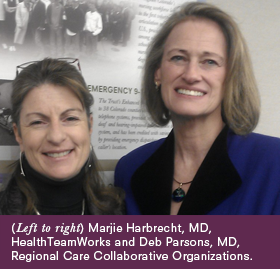
At a Workforce Collaborative meeting in December, Marjie Harbrecht, MD, CEO of HealthTeamWorks, presented options for transforming Colorado’s health care system by using current workers more effectively while adding new job skills into the market. In particular, jobs related to care coordination are expected to gain more prominence as patient-centered medical home models focus on providing high-quality, safe, coordinated care with a focus on building partnership between patients and their personal health care team. Care coordinators can help patients navigate our fragmented health care system by setting appointments and coordinating care not only within the practice, but between different providers, labs, community settings and hospitals.
Joining Dr. Harbrecht for this workforce discussion was Deb Parsons, MD, Senior Medical Director, Regional Care Collaborative Organizations (RCCO) Region 3, Colorado Access. Dr. Parson echoed the importance of Dr. Harbrecht’s recommendations, describing the importance of care coordination through transitions of care, enhanced payment to primary care providers for participation in care management and connecting enrolled patients with a primary care medical provider as key goals of Medicaid’s RCCO program. Designed to improve the patient experience and health outcomes and reduce costs, RCCOs would be the delivery system for Medicaid should expansion of this public insurance program be approved in Colorado.
Central to the RCCO model is timely and effective care management and care coordination. Yet, fundamental definitions and descriptions of such roles are inconsistent. What should excellent care management look like? What are the desired knowledge, skills and attitudes that such a person would need? What would a care manager optimally do and how would they do it? Answers to these questions could assist our universities in training students for these roles and inform payers about reimbursements for care coordination and management.
With these opportunities at hand, the Collaborative has an important role in continuing to provide information to state policy leaders. What aspects of developing and expanding Colorado’s primary care workforce do you see as most critical to ensure we are best able to meet the health care needs of all Coloradans?
Click here to access the Workforce Collaborative’s public policy recommendations.
Special thanks to Kaia Gallagher, Center for Research Strategies; Marjie Harbrecht, MD, HealthTeamWorks; and Deb Parsons, MD for their contributions to this blog.