
Seeding Connections for a Healthy Region
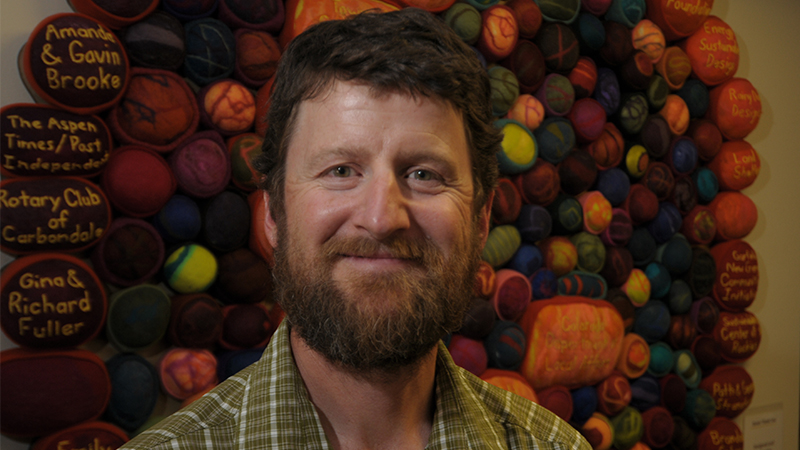
Colin Laird of Healthy Mountain Communities. Over the last 16 years, Healthy Mountain Communities has brought solutions to problems throughout the nine communities that make up this region.
“In recognition of The Colorado Trust’s 25th anniversary, we are featuring stories throughout the year noting the accomplishments of a few of the many remarkable people, organizations and communities we have had the privilege of working with over the years on our shared goal of improving the health and well-being of Coloradans.
On a blustery spring morning in Carbondale, Colorado, the old elementary school is nearly empty. Peering through a classroom door window, a group of seniors is intent on their Tai Chi moves. Behind another, a few adults with developmental disabilities are watching TV or socializing.
Soon, however, the newly minted Third Street Center will be teeming with activity.
Third Street Center, a new, energy-efficient workspace that is home to more than two-dozen organizations is the latest example of remarkable accomplishments by a rural region working together. Citizens from nine communities in the Roaring Fork Valley, from Aspen to Parachute, joined forces nearly 20 years ago to determine and resolve shared needs and aspirations.
This regional cooperation began with the creation of Healthy Mountain Communities (HMC), a citizen-led initiative started with seed funding from The Colorado Trust’s statewide Healthy Communities Initiative in 1992. HMC was established to gather data to help increase awareness and understanding about community needs and challenges, and to forge regional connections to resolve broad health issues and improve the overall quality of life for Roaring Fork Valley residents.
A changing economy and the inability to solve complex problems at the city or county level were the impetus for coming together as a region. “”Local political boundaries created barriers to small communities reaching a solution on our own,”” says Colin Laird, HMC Director since 1994. “”There was an increasing trend for people to live down valley and work up valley as housing prices increased. Thus, affordable housing, transportation, discrimination, access to health care, viable business development were all issues that needed to be grappled with.””
HMC became the vehicle and created tools for citizens, business leaders and local officials to work together in exciting, new ways to create and promote a shared definition of health in their communities. Today the region’s residents are closer than ever, having engineered the state’s second largest transit authority, a community development corporation, an informal coalition of mayors, ongoing discussions of challenging issues – such as how to make health insurance available and affordable to all who need it – and numerous other initiatives led by HMC.
Key to all of these efforts is a foundation of trust built by the individuals who live here that has led to the willingness, capacity and communications channels to keep working together. Years in the making, HMC marked the completion this month of its $4.34 million project to re-purpose the former school by inviting the entire community in to celebrate. Bringing the region’s vibrant network of human and social service, environmental and arts organizations under one roof offers benefits to all tenants, including long-term affordable rents and control over their space as well as opportunities to network in new ways to strengthen the communities they serve.
“”Third Street Center provides an integrated community setting where our folks can participate in activities with an array of other people,”” says Mountain Valley Developmental Services Executive Director Bruce Christensen, one of the first tenants who operates a day center onsite for adults with developmental disabilities. “”Plus the synergy of having all the regional nonprofits in one place where we can work together and get to know each other better.””
Laird agrees. “”Creating this space was a lesson in collaboration and it embodies that idea,”” he says. “”This is a place for people to go to places we’ve never been before in terms of identifying problems and creating solutions.”””
